The Shift Towards Native Case Handling: Auto-Traying and Case-to-Shelf Systems
Traditionally, warehouses have relied heavily on pallet operations for storage and transport. However, with advancements in technology, the industry is now witnessing a significant shift towards more efficient native case handling methods such as auto-traying and direct case-to-shelf systems. This transition is driven by the need to reduce labor costs, minimize damage during handling, and increase overall throughput. Auto-traying, for instance, automates the process of placing individual items into trays, which are then easily transported through the warehouse using conveyor belts or robotic arms. Similarly, case-to-shelf systems allow products to be directly shelved from incoming shipments without intermediate steps, significantly streamlining operations.
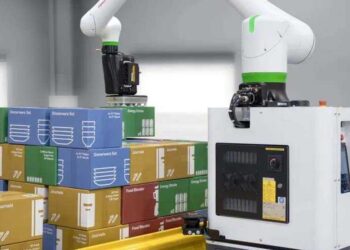
The adoption of these methods is further bolstered by advancements in robotic technology that can handle mixed-size cartons with precision and speed. Robotic solutions such as collaborative robots (cobots) are designed to work alongside human workers, reducing the burden on manual labor while increasing operational efficiency. These cobots are equipped with advanced sensors and algorithms that enable them to grasp and maneuver items of varying sizes and weights accurately.
Inbound Automation: The Next Frontier for ROI
Historically, inbound processes in warehouses have been a significant bottleneck due to their reliance on manual labor and time-consuming tasks such as de-palletizing and pallet-building. However, with the advent of advanced automation technologies, this landscape is rapidly changing. In 2026, expect major investments in robotic de-palletizing systems that can efficiently remove products from pallets, and pallet-building robots that can assemble new pallets for outbound shipments without human intervention.
Additionally, AI-enabled vision inspection systems are being integrated into inbound operations to ensure quality control. These systems use machine learning algorithms to detect defects or anomalies in incoming goods quickly, thereby reducing the likelihood of substandard products entering inventory. Autonomous mobile robots (AMRs) are also playing a crucial role by transporting cases and pallets within the warehouse autonomously. This not only frees up human workers for more complex tasks but also enhances overall efficiency and throughput.
Robotics-as-a-Service: Democratizing Automation
The concept of Robotics-as-a-Service (RaaS) is revolutionizing how warehouses access automation technology. Traditionally, implementing advanced robotics required significant upfront capital investment, which often deterred smaller or mid-sized operations from adopting these technologies. RaaS models allow businesses to lease robotic systems on a subscription basis, significantly reducing the financial barrier to entry.
This shift towards RaaS is not only making top-tier automation technology accessible but also enabling warehouses to scale their operations more flexibly. Businesses can now adapt to changing demand by adding or removing robotic units as needed, without being locked into long-term purchase agreements. This flexibility is particularly beneficial for businesses in industries with fluctuating demands such as retail and e-commerce.
Software-Defined Warehouses: The Role of Warehouse Execution Systems (WES)
The evolution of warehouse automation is not just about hardware; it’s increasingly driven by sophisticated software solutions. One critical component in this transformation is the Warehouse Execution System (WES). WES acts as a central nervous system for automated warehouses, integrating and coordinating various subsystems such as Automated Storage and Retrieval Systems (AS/RS), conveyors, Autonomous Mobile Robots (AMRs), and robotic arms.
By unifying these disparate systems, WES enables real-time orchestration of warehouse operations. This means that tasks can be dynamically adjusted based on current needs and predicted future demands. For example, the system might automatically reroute products to different storage locations to optimize space usage or prioritize certain tasks during peak periods. Furthermore, WES allows for virtual testing and simulation of workflows before they are implemented in real-world settings, reducing downtime and ensuring smooth operations.
The Force Multiplier: AI’s Role in Predictive Maintenance
Artificial Intelligence (AI) is playing an increasingly pivotal role in warehouse automation by enabling predictive maintenance. Traditionally, maintenance was reactive, with equipment being serviced only after a failure occurred. This not only led to costly downtime but also reduced overall efficiency.
Absorbing vast amounts of sensor data from connected devices within the warehouse ecosystem, AI algorithms can predict potential failures before they occur. By analyzing patterns and anomalies in real-time performance metrics, these systems alert maintenance teams proactively, allowing for timely interventions that prevent breakdowns. This predictive approach to maintenance not only reduces downtime but also extends the lifespan of equipment by addressing issues early on.
The Continuous Optimization Loop: Smart Orchestration and Vision Systems
AI-driven smart orchestration is transforming how warehouse tasks are assigned and executed. Traditional task allocation methods relied heavily on human managers who had to manually assign work based on their experience and judgment. However, AI algorithms can continuously optimize these assignments by analyzing real-time data from various sources such as sensor inputs, inventory levels, and worker availability.
Similarly, vision systems powered by AI are enhancing quality control processes. These systems use high-resolution cameras and machine learning models to verify product conditions almost instantaneously. Whether it’s checking for correct packaging or inspecting for defects, these vision systems ensure that only products meeting the highest standards proceed through the supply chain.
Source: TechCrunch