Fighting Supply Chain Disruptions with AI: A $62 Billion Opportunity
The core supply chain sector remains under-served technologically, and we see tremendous potential in three key areas.
Ashu Garg, Jaya Gupta
The pandemic exposed the fragility of global supply chains. To understand this vulnerability, one only needs to look at the furniture industry, which experienced record sales early on but then faced a series of bankruptcies due to container shortages, raw material scarcity, and prolonged delays in receiving critical components. Although the most visible supply chain crises may have passed, some level of fragmentation and chaos in cargo flow has become the norm. Overall, supply chain disruptions have caused about $1.6 trillion in economic losses over the past few years. Looking at supply chain disruptions over the last decade, an average company expects to lose nearly half a year’s profit.
As supply chains declined, LLMs (large language models) and automation advanced. We are entering a new era of process automation that promises to streamline operations across all data-intensive industries, including global supply chains. No longer is it traditional rule-based automation; instead, LLM-driven solutions can learn and improve over time. Better yet, they can handle both structured and unstructured data (both types abound in supply chains).
After years of product shortages, high food prices, and delayed deliveries, we find ourselves at a unique juncture where there is not only the willingness but also the means to change by integrating AI into supply chain management software. Historically, supply chains have been fragmented, but AI promises to unify disparate data sources and systems and replace cumbersome manual processes throughout the supply chain. Although core supply chain areas may still be technologically under-served, we see significant opportunities for AI in three specific domains: procurement, supplier intelligence, and demand planning.
Three Major Factors Behind Supply Chain Disruptions
Supply chain data is scattered almost everywhere—in emails, scanned documents, and isolated, outdated software. Three key factors particularly contribute to the fragmentation of global supply chains:
- Communication Tools Rely on Unstructured Data: such as emails, text messages, and scanned files. This unstructured data often contains critical information that is difficult to extract and analyze systematically, complicating supplier communications. For example, Tesla’s production delays were partly due to missing chip shortages information in emails, which led to a shortfall of vehicle production in the third quarter of 2021.
- Outdated and Uneven Adoption of Electronic Data Interchange (EDI) Systems: EDI is a system for exchanging commercial documents introduced in the ’60s and adopted by major manufacturers in the ’90s. In the furniture industry mentioned earlier, when a large company like La-Z-Boy wants to produce 50,000 leather recliners, they might send an EDI request to overseas suppliers for bidding and then let their procurement teams choose from these bids. However, small and medium-sized companies struggle with adopting EDI due to the lack of standard operating procedures, finding themselves stuck in lengthy negotiations over multiple channels and platforms with overseas suppliers. EDI also poses challenges to organizations because of its inflexibility and integration capabilities. Even Walmart experienced delays and additional costs when modifying its existing EDI infrastructure for a new direct shipment program launched in 2020.
- Many Companies Use Multiple Management Systems, including ERP (Enterprise Resource Planning), WMS (Warehouse Management System), and TMS (Transportation Management System), creating data silos that hinder end-to-end supply chain visibility. Unilever reported a 23% increase in stockouts and a 17% rise in excess inventory across its global operations in 2022 due to poor communication between its ERP and WMS systems.
In the past decade, digitalization has helped alleviate this issue. Solutions like project44, FourKites, and Tive aggregate supply chain data through APIs. However, more work is needed. According to a McKinsey survey, nearly half of respondents have not made significant investments in core digital supply chain building blocks such as Advanced Planning Systems (APS), WMS, or TMS. The foundation for the next layer of smart technologies already exists, and startups can leverage AI to parse unstructured data and unify different software systems.
A $62 Billion Market Opportunity for AI
The supply chain management industry presents significant potential for disruption. According to Gartner, annual spending on software in this field is expected to grow from $29 billion in 2023 to $62 billion by 2028, with a compound annual growth rate of 16.3%.
We believe that well-positioned, innovative, and fast-moving AI startups can capture this market. AI can categorize visual, numerical, and textual data to model complex scenarios with high accuracy. For example, computer vision systems can now inspect products on an assembly line more consistently than human quality control teams in identifying defects. Machine learning algorithms can predict demand with unprecedented accuracy by analyzing factors ranging from historical purchase patterns to political unrest, labor conditions, and weather.
In supply chain management, many tasks are highly repetitive and time-consuming, making these capabilities particularly useful. By fine-tuning LLMs for the supply chain domain, companies can use AI to extract insights from unstructured documents. These analyses can be easily deployed into business intelligence software used by supply chain managers. LLMs can also leverage this data to answer questions such as “Which supplier offers the most competitive pricing for my needs?” and “Which suppliers are least likely to experience disruptions?”
Currently, generative AI has made some progress. Supply chain and inventory management functions are considered business capabilities that have seen significant revenue growth due to generative AI. Particularly in three areas, AI’s potential is the highest:
- Purchasing: acquiring goods for company operations
- Supplier Intelligence: collecting data to evaluate and optimize supplier relationships
- Demand Planning: forecasting future customer demand to ensure optimal supply
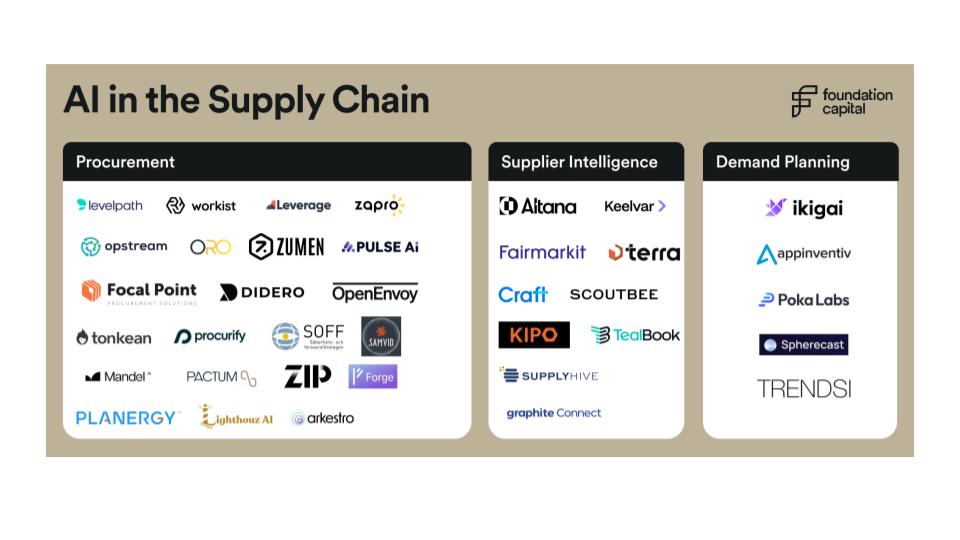
In all three areas, AI can significantly accelerate data analysis processes and supply chain management. We have also mapped the market in each area with a focus on AI-driven supply chain startups.
Why Procurement Tasks Are Suitable for Automation
Purchasing is crucial for ensuring stable material supplies, maintaining supplier relationships, and boosting profits. Our portfolio company Tonkean excels at automating many procurement processes, whether coordinating contract renewals or handling invoices.
An emerging solution is Robotic Process Automation (RPA), which uses rule-based methods to automate input processes. Unfortunately, much of the input comes from large amounts of unstructured data that RPA cannot handle, such as emails and PDFs. A new wave of early-stage companies like Didero, Lighthouz AI, and Soff are using AI to sift through insights in unstructured data.
These insights are increasingly being used by procurement teams. Startup Pulse AI is creating a search engine that can retrieve non-structured data to answer supply chain questions. Mandel AI has developed a supply chain agent that automatically updates ERP when supplier delivery times and prices change.
In the future, we see more growth potential for early-stage ventures. Startups are leveraging game theory simulations in procurement team negotiations with suppliers. LLMs can automate various aspects of supplier communication, such as generating purchase orders and handling request-for-quote processes.
How AI Enhances Supplier Intelligence
To find the best suppliers, companies must balance compliance requirements, different quotes, and market changes. Additionally, having multiple suppliers enhances supply chain resilience in the face of events like COVID-19 or other emergencies.
AIs create possibilities for intelligent supplier mapping and matching compared to simple search bars. Altana is a leader in this field, creating smart value chains across different levels of the supply chain. Companies can use its LLM assistant to query specific suppliers. Furthermore, Keelvar and Fairmarkit offer AI-supported platforms that make it easy for procurement teams to find suppliers. Emerging players like Kipo AI and Terra are developing platforms that make it easier for companies to match with suppliers.
Demand Planning Beyond Historical Data
Predicting supply and demand changes can prevent supply chain disruptions from affecting consumers. Traditional planning software mainly relies on historical data for predictions. While this method has some accuracy, it may not be sufficient in rapidly changing markets and geopolitical conditions.
Luckily, AI can improve planning capabilities by considering both historical data and current market trends. Research also shows that AI can detect “panic buying” instances, such as toilet paper hoarding during the pandemic, by identifying anomalies and categorizing them as relevant or irrelevant. These planning algorithms can bring meaningful results to businesses. According to McKinsey, companies using advanced analytics for demand forecasting have seen a 10% reduction in inventory levels.
Redefining Supply Chains with AI
The supply chain industry possesses two elements that make it a prime opportunity for AI startups: isolated software management systems and vast amounts of unstructured data. Whether in procurement, supplier intelligence, demand planning, or other areas, we believe AI will disrupt and enhance the supply chain significantly over the next few years.
We are actively investing in this field. If you’re building an AI-focused startup to transform supply chain management, please contact us.
Thanks to Tushar Dalmia for support and research on this article.
Source: Foundation Capital