Aurora: Autonomous Trucks Can Reduce Risks and Insurance Costs
==============================================================
Autonomous trucks can help fleet operators reduce costs by avoiding and mitigating accidents, according to the development company.

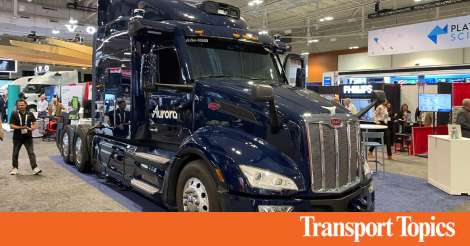
Aurora showcased its autonomous technology installed on a Peterbilt Model 579 at MCE 2024. (Seth Clevenger/Transport Topics)
Nashville, Tennessee – According to an executive from Aurora, the developer of autonomous trucks, these vehicles can mitigate liability risks in the trucking industry and reduce rising insurance costs by proactively identifying potential safety hazards and avoiding or mitigating accidents.
“We believe we will be able to significantly reduce both the frequency and severity of incidents on the road. This is a huge value proposition for the industry,” said Zac Andreoni, Aurora’s vice president of business development.
While insurance coverage and accident liability remain one of the most common issues in deploying autonomous vehicles, Andreoni views these as opportunities for technology advancement, especially when facing litigation threats to the industry.
“We know you operate in an extremely challenging and litigious environment. The situation out there is pretty bad,” he said at an educational session during the American Trucking Associations’ 2024 Management Conference & Exhibition on October 14.
When accidents occur, autonomous trucks can provide more data to authorities and insurers to reconstruct these scenarios and appropriately allocate liability, Andreoni said. “This should ultimately reduce claim costs.”
During the conference, he showed some videos demonstrating how Aurora Driver, the company’s autonomous system, handles various safety risks during road tests.
In one example, an autonomous truck approached a green light intersection but stopped despite having the right of way because it detected a speeding pickup truck that could not stop in time. The pickup ran the red light and collided with another vehicle continuing through the green light, but the Aurora truck avoided the accident by stopping before reaching the intersection.
In another scenario, a pedestrian suddenly ran across a highway during the daytime. This would be a tense situation for human drivers, but Aurora Driver detected the pedestrian from afar and planned to safely avoid it.
“It is not only vigilant but also always calm,” Andreoni said of the autonomous system. “It makes such situations insignificant.”
In addition to road testing, Aurora heavily relies on simulations to accelerate validation of its systems to ensure appropriate responses to extremely rare safety scenarios on the roads.
Previously, Aurora ran simulations to test how its system would handle fatal accidents involving commercial trucks, especially along the I-45 corridor between Dallas and Houston, where the company plans to launch its first autonomous truck lane.
Recently, Aurora has been simulating real-world accident scenarios that have led to substantial judgments against trucking companies.
In one such case, a distracted pedestrian walked into the street and was struck by a turning truck trailer, resulting in death. According to Aurora’s simulation of this incident, its virtual driver would detect the pedestrian within the sweep space of the trailer and stop to prevent the accident.
“It is important to note that we do not believe we can avoid every scenario. Accidents will happen at some point,” Andreoni said. “So far, all the incidents we have been involved in were caused by others hitting us… In these cases, we can provide a lot of data about what actually happened.”
In addition to safety benefits, autonomous trucks can supplement the industry’s workforce and help alleviate labor shortages while improving freight efficiency, Andreoni said.
Autonomous technology does not get fatigued and will not stop due to exhausted driving hours as mandated by federal regulations.
“It is not subject to work hour limitations,” Andreoni said. “This enables us to deliver goods faster and increase asset utilization.”
Currently, Aurora regularly uses its autonomous tractors with backup drivers to transport goods for industry partners while working on the safety validation of its autonomous system.
Andreoni stated that Aurora remains focused on achieving its previously announced goal of beginning driverless operations between Houston and Dallas by the end of this year.
Aurora also plans to start testing autonomous trucks on a 1,000-mile lane between Phoenix and Fort Worth (Texas) in the first half of 2025 and aims to achieve full autonomy on that route later in the year.
At the MCE exhibition, two Class 8 tractors equipped with Aurora’s autonomous system were displayed – a Peterbilt Model 579 and a new Volvo VNL.
Apart from Aurora, several companies are currently developing autonomous technology for commercial trucks, including Torc Robotics, Kodiak Robotics, Plus, Gatik, Stack AV, Waabi, Bot Auto, Einride, and Forterra.
—
Source: Transport Topics