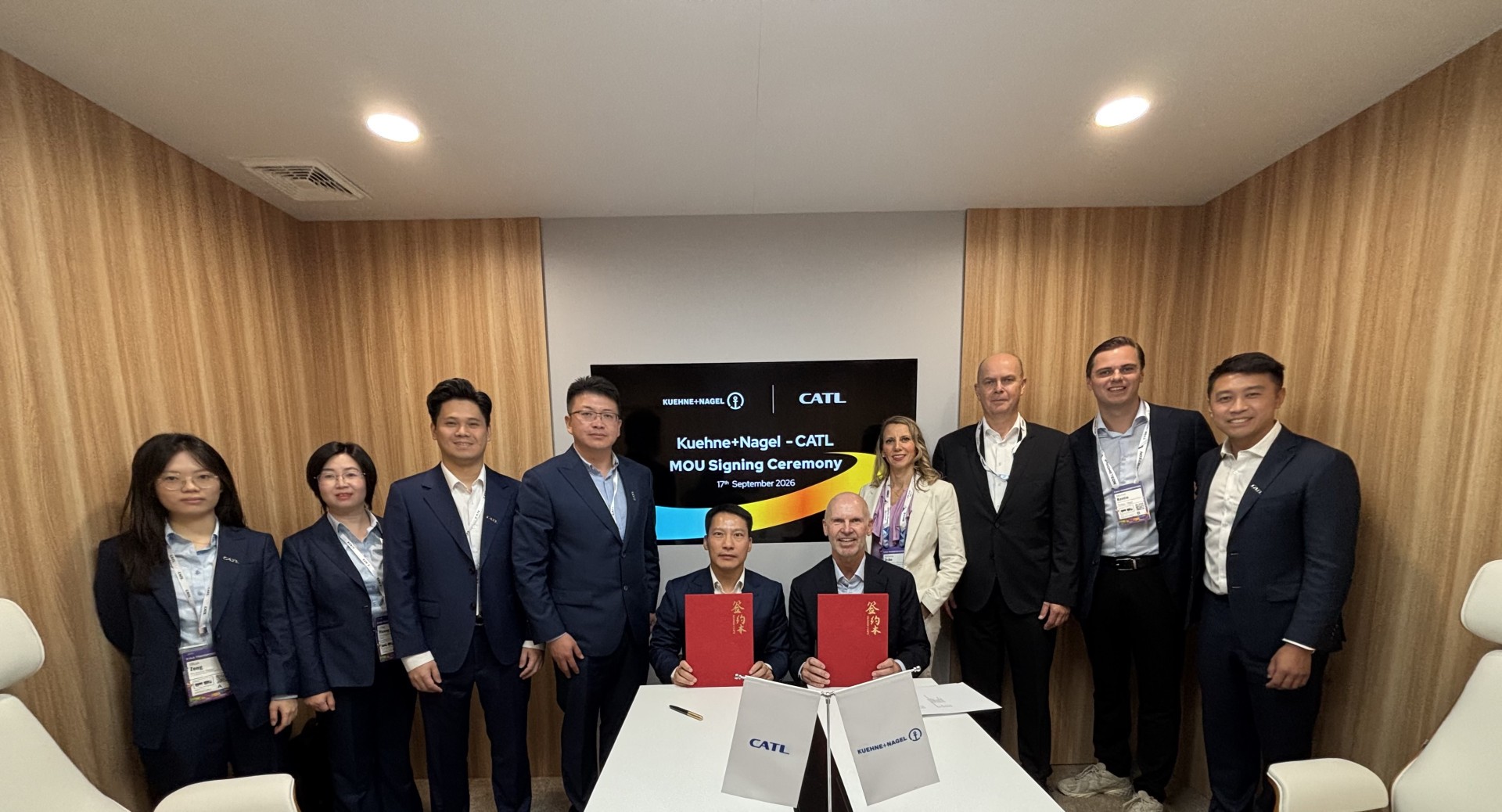
According to container-news.com, Kuehne+Nagel and battery manufacturer CATL have signed a Memorandum of Understanding (MoU) to collaborate on battery logistics, transport electrification, and emissions reduction — with initial projects launching in Europe and Asia.
Battery-Swapping Pilot and European Electrification
One of the first initiatives will be a battery-swapping pilot for heavy-duty trucks in China, scheduled to launch in 2026. The pilot will use technology provided by Qiji. Separately, the partners will work to electrify CATL’s transport flows across Europe, though specific details — such as the number of vehicles or routes involved — were not disclosed in the agreement.
The partnership targets concrete decarbonisation outcomes across logistics value chains, particularly focusing on reducing Scope 3 emissions. According to the companies, global demand for batteries used in electric trucks rose by more than 75% in 2024, reflecting accelerating adoption trends aligned with the pilot’s timeline and regional rollout plans.
Broader Collaboration Scope
Beyond vehicle electrification, Kuehne+Nagel and CATL will explore joint efforts in battery recycling, aftersales support, energy storage, and charging infrastructure for logistics facilities. These activities are explicitly intended to support emissions reduction across both companies’ operations and those of their customers.
“Battery-electric vehicles are essential to decarbonising road freight,” said Søren Schmidt, Executive Vice President Road Logistics at Kuehne+Nagel. “Accelerating the transition requires solutions that are both high-performing and operationally viable.” He emphasized that integrating CATL’s battery expertise with Kuehne+Nagel’s logistics capabilities enables scalable, real-world deployment.
Strategic Alignment and Undisclosed Scale
Akin Li, Executive President of CATL Overseas Business, stated: “As global leaders in our respective industries, CATL and Kuehne+Nagel share a commitment to accelerating the energy transition and achieving a net-zero emissions future.” The companies confirmed no investment value or expanded timeframe beyond the initial projects has been disclosed.
The MoU reflects coordinated action amid expanding global battery manufacturing capacity and surging demand — with the 75% growth in electric truck battery demand in 2024 serving as a key market signal underpinning the partnership’s urgency and scope. The collaboration spans two major geographies: China and Europe.
Source: container-news.com
Compiled from international media by the SCI.AI editorial team.