According to www.marketscale.com, FedEx CEO Raj Subramaniam described the current global supply chain upheaval as the largest realignment he has witnessed in 35 years — a structural transformation driven by tariffs, geopolitical tensions, and shifting sourcing strategies.
Reglobalization, not deglobalization
Subramaniam’s framing, as reported by Fortune, rejects the notion of deglobalization. Instead, he emphasized reglobalization: trade is not shrinking but rerouting. Growth corridors in Latin America, Southeast Asia, and India are absorbing volume once concentrated on traditional Asia-to-North America and Asia-to-Europe lanes. This redirection demands rapid reassessment of long-standing trade routes — turning new carrier partnerships and customs capabilities in emerging corridors into operational imperatives, not strategic options.
Tariffs serve as a central accelerant. Subramaniam told Fortune that unpredictable tariff environments are compressing multi-year supply chain redesign timelines into mere months. With FedEx moving nearly $2 trillion worth of goods annually, its network functions as a real-time referendum on the state of global trade. A supply chain optimized for yesterday’s trade map, he warned, is now a liability — not an asset.
Three simultaneous transformations inside FedEx
FedEx is responding with three concurrent strategic initiatives: unifying its Express and Ground networks into a single operating structure; scaling digital capabilities tailored to e-commerce; and deploying automation across hub infrastructure. These efforts reflect a deliberate, integrated response — not reactive patchwork.
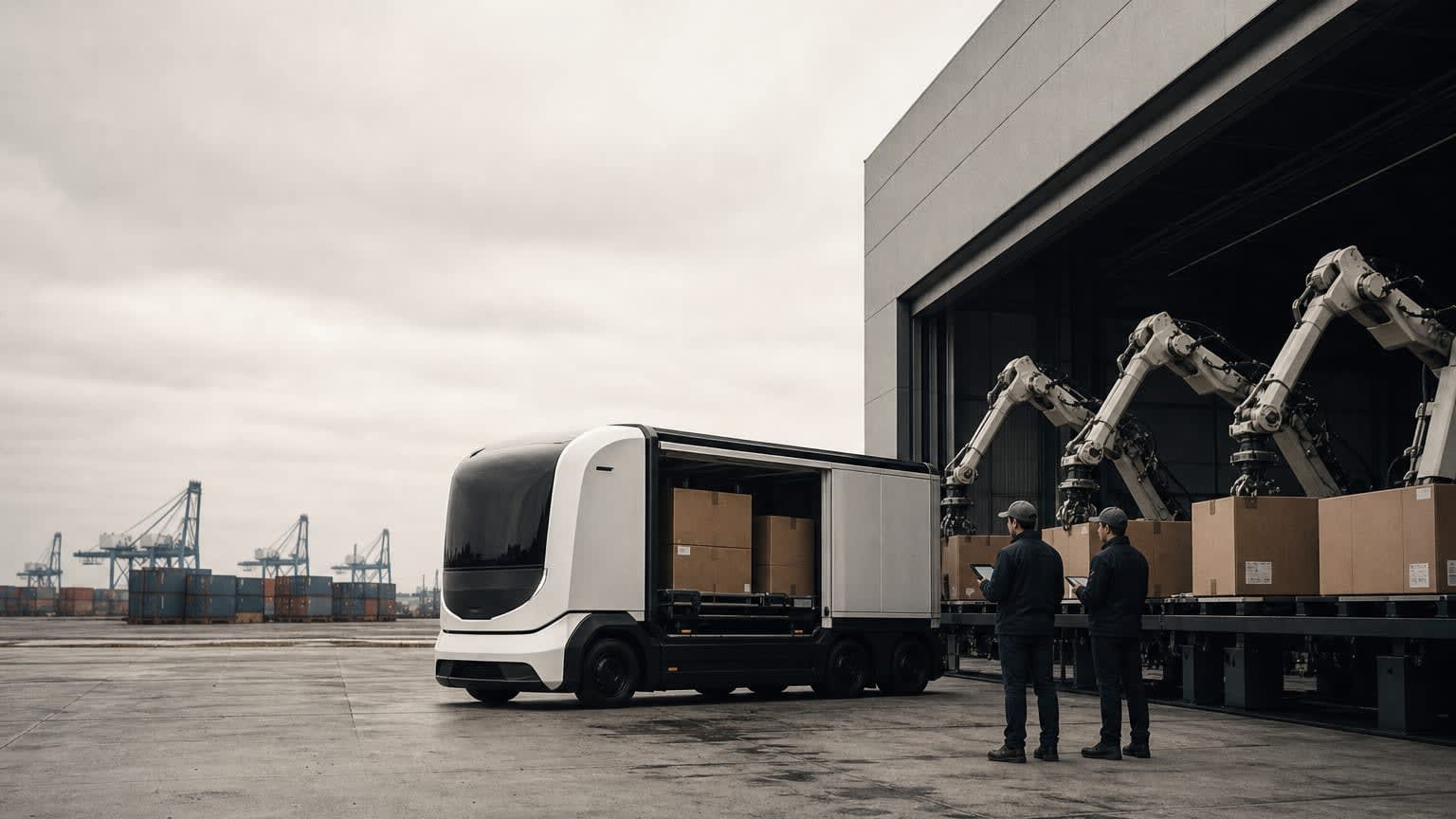
The automation rollout includes concrete, measurable deployments. FedEx is testing autonomous trucks on highway routes through a partnership with Aurora. This targets the long-haul segment, where driver shortages and labor costs represent the sharpest operational pressure points. Inside sorting hubs, FedEx is collaborating with Dexterity and Berkshire Grey to automate truck loading and unloading — tasks historically resistant to mechanization due to variability in package size, weight, and sequencing.
Further, Subramaniam stated that FedEx views its logistics data as a product in its own right — capable of supporting customs processes, predicting disruptions before they occur, and powering new services for high-value supply chains.
“FedEx views its logistics data as a potential product in its own right, capable of supporting customs processes, predicting disruptions before they materialize, and powering new services for high-value supply chains.” — Raj Subramaniam, CEO of FedEx
For enterprise shippers, this signals a strategic pivot: intelligence is becoming a competitive differentiator, not just a back-office efficiency tool.
South Africa: infrastructure capital and advocacy alignment
The global restructuring echoes regionally. On July 16, 2026, the Road Freight Association and the South African Freight and Logistics Association formalized a strategic partnership, signing a Memorandum of Understanding to create a unified advocacy framework covering both road freight and freight forwarding — a move aimed at strengthening industry influence with regulators and infrastructure planners.
Capital is also flowing into physical infrastructure. Logistics developer Newlyn closed R5 billion in financing earlier in July 2026, according to Logistics News. That sum — roughly equivalent to a major industrial real estate program — reflects sustained institutional confidence in regional distribution capacity amid global supply chain redesign. Meanwhile, Alan Richard, managing director of Apex Real Time Solutions, noted in Logistics News on July 17, 2026 that returns have become a structural challenge for South African FMCG and retail operators — underscoring how warehouse management systems directly impact reverse logistics efficiency, a concern mirrored in FedEx’s robotics investments.
What this means for supply chain teams
Procurement and logistics professionals face urgent, actionable implications. First, audit trade lane assumptions: if sourcing or distribution footprints were built around pre-2025 tariff structures, Subramaniam’s assessment of this as a multi-year structural shift — not a temporary disruption — warrants a formal lane-by-lane review.
- Evaluate carrier automation readiness: FedEx’s deployment of Aurora autonomous trucks and Dexterity/Berkshire Grey hub robotics will affect service timelines, capacity availability, and pricing models — requiring direct engagement with carrier roadmaps.
- Watch customs capability as a differentiator: FedEx’s AI-driven customs support signals that logistics providers will increasingly compete on data intelligence — a capability procurement teams must assess during carrier contract renewals.
- In southern Africa, track the RFA–SAFLA MOU: a unified industry voice can accelerate or complicate regulatory changes affecting cross-border freight costs and timelines.
Source: marketscale.com
Compiled from international media by the SCI.AI editorial team.