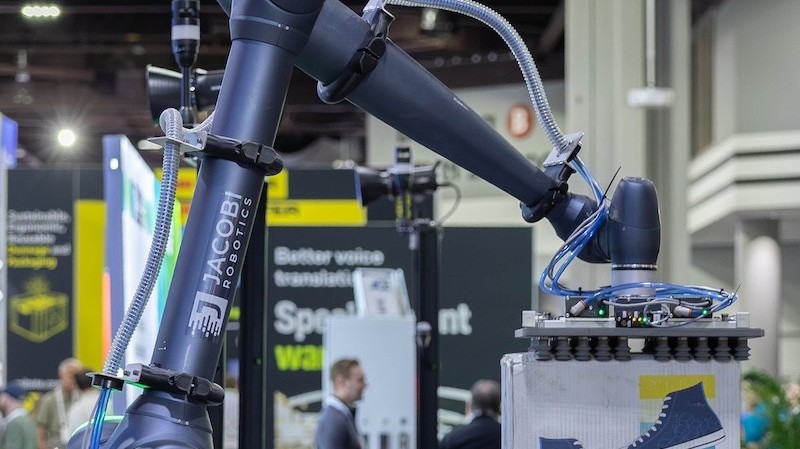
According to roboticsandautomationnews.com, Peak Technologies has partnered with Jacobi Robotics to deliver an AI-powered mixed-case palletizing solution for complex warehouses and distribution centers. The collaboration centers on the Jacobi OmniPalletizer — described as a physical AI platform — integrated with Peak Technologies’ enterprise technology deployment capabilities.
Eliminating Upstream Complexity
The OmniPalletizer is designed to remove the need for upstream buffering, sorting, and sequencing — traditionally required steps in conventional mixed-case palletizing workflows. This capability enables rapid, non-disruptive deployment within active brownfield facilities. According to the report, the turnkey solution is suitable for retail, grocery, beverage, fast-moving consumer goods (FMCG), parcel, and third-party logistics (3PL) operations.
Real-Time Adaptation via Physical AI
Leveraging real-time motion planning, computer vision, and self-learning AI, the OmniPalletizer dynamically adjusts to case variables — including product mix, packaging dimensions, and arrival patterns — without manual programming. It honors operational constraints such as heavy-to-light stacking priority and crush limits. Onboard digital twin technology allows users to validate system performance using their own historical data, delivering actionable insights from day one.
Executive Perspective
“Mixed-case palletizing is traditionally one of the most time- and cost-intensive workflows in warehouse environments, often forcing operations teams to trade off between automation and flexibility. Our partnership with Jacobi Robotics eliminates that constraint by providing a fully packaged solution that adapts to real-world variability without adding upstream complexity.” — Tony Rivers, president and CEO at Peak Technologies
Implementation Advantages
- Rapid deployment backed by Peak Technologies’ systems engineering and on-site integration expertise
- Low-risk transition path from manual to automated mixed-case palletizing
- No disruption to existing workflows during implementation
- Support for store-ready, stable, and dense pallet configurations
This development arrives amid accelerating adoption of AI-driven material handling solutions across global supply chains. Industry-wide, mixed-case palletizing has long represented a bottleneck due to SKU variability and legacy line constraints — a challenge also addressed recently by companies like Locus Robotics (with adaptive AMR-based sortation) and Honeywell Intelligrated (via modular robotic palletizers). Unlike traditional robotic palletizers requiring extensive case standardization or pre-sorting, the OmniPalletizer’s physical AI architecture reflects a broader shift toward adaptive, data-native automation — consistent with trends observed in 2025–2026 deployments across North American FMCG and grocery DCs. For supply chain professionals, this means reduced dependency on upstream process re-engineering, faster ROI timelines, and greater agility in handling seasonal or promotional SKUs without infrastructure overhauls.
Source: Robotics & Automation News
Compiled from international media by the SCI.AI editorial team.