According to www.microsoft.com, Microsoft is advancing what it terms Supply Chain 2.0—a shift from generative AI to autonomous, reasoning AI agents integrated with physical systems and high-fidelity simulations across its global logistics operations. This transformation represents a fundamental evolution from traditional human-driven supply chain management to autonomous intelligent systems.
Microsoft’s ‘Customer Zero’ Transformation
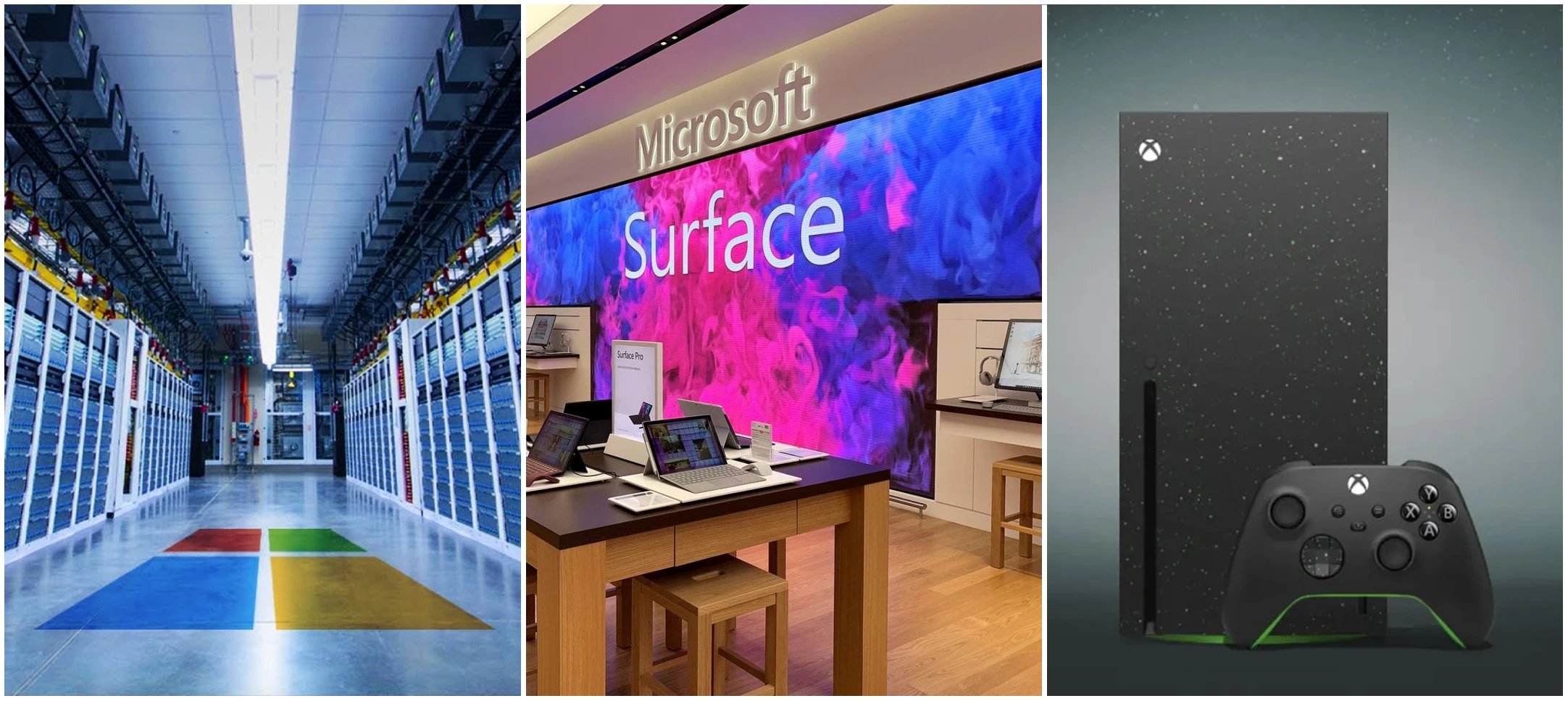
Microsoft operates one of the world’s most extensive cloud supply chains, spanning more than 70 Azure regions, over 400 datacenters, and a fiber network exceeding 600,000 km. Its supply chains also support Windows and Devices—including Surface hardware, PC accessories, Xbox consoles, and gaming hardware. Over the past decade, Microsoft evolved from Excel-based reporting and siloed data to a unified, AI-driven architecture. In 2018, it consolidated more than 30 legacy systems into a single supply chain data lake on Azure. By 2022, it began experimenting with generative AI and later built an AI platform to operationalize agents at scale. Today, more than 25 AI agents and applications are deployed, with a goal to operate over 100 agents by the end of 2026 and equip every employee with agentic support.
Three Production-Ready AI Agents
- Demand Planning Agent: Drives AI-based demand simulations for non-IT rack components—improving forecast accuracy and reducing manual reconciliation.
- Multi-Agent DC Spare-Part Space Solver: Uses computer-vision-driven monitoring and multi-agent reasoning to forecast spare-part storage needs and proactively mitigate space or stockout risks.
- CargoPilot Agent: Continuously analyzes transport modes, routes, cost structures, carbon impact, and cycle times—delivering optimized shipment recommendations that balance speed, sustainability, and efficiency.
The impact is measurable: AI in logistics is saving Microsoft teams hundreds of hours each month, demonstrating direct translation of agentic operations into efficiency and business value. This success not only benefits internal operations but also provides replicable case studies for Microsoft’s customers.
“Our goal is to operate over 100 AI agents by the end of 2026 and equip every employee with agentic support. AI in logistics is already saving our teams hundreds of hours each month, demonstrating the direct translation of agentic operations into efficiency and business value.” — Microsoft Supply Chain Team
Three Foundational Capabilities
Microsoft identifies three interlocking pillars for unlocking AI value in supply chains:
- Enabling AI-powered supply chain simulations: Discrete event-based simulations (DES) allow risk-free virtual modeling of interventions and variables. Tools like Azure Machine Learning and Microsoft Fabric’s new machine learning model—integrated with Power BI semantic models—support simulation of demand patterns, shortages, and disruptions.
- Building agentic supply chains: Leveraging end-to-end agent hosting in Microsoft Foundry and open protocols such as the Model Context Protocol (MCP), agents now reason, plan, and act across enterprise systems, tools, and data.
- Integrating first physical AI innovations: Platforms like NVIDIA Cosmos (with world foundation models) and OSMO edge-to-cloud compute framework on Azure enable machines and humanoid robots to operate effectively in physical environments—including warehouses, distribution centers, and transportation networks.
Advanced Simulation: Digital Twin Foundation
More advanced simulation techniques combine multi-physics simulation in 3D environments with discrete event simulation, enabling teams to build comprehensive digital twins of warehouses, distribution centers, production lines, and logistics networks. These virtual environments allow organizations to simulate both the physical behavior of assets and the dynamic flow of operations simultaneously.
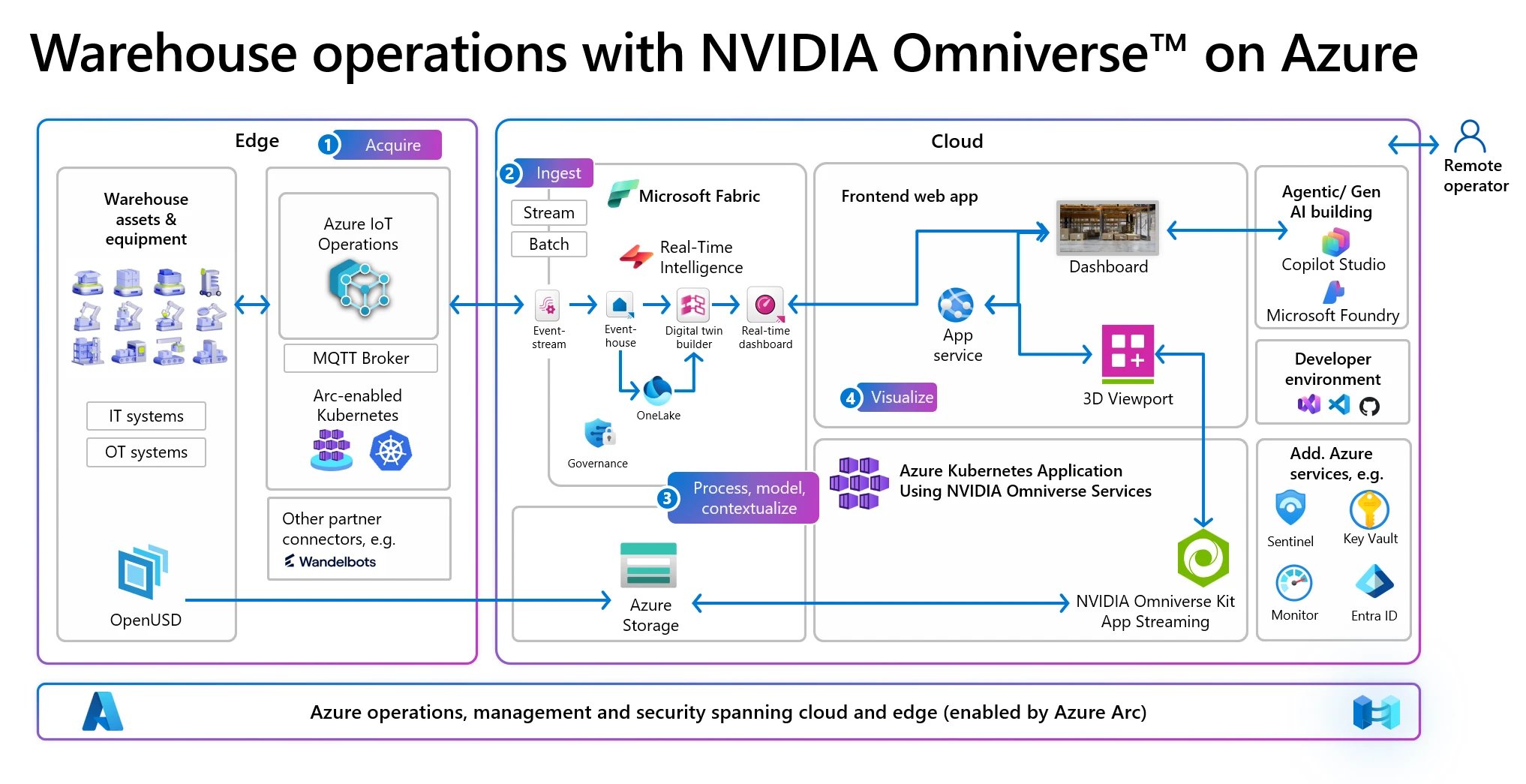
Through its partnership with NVIDIA, Microsoft provides access to libraries and frameworks such as NVIDIA Omniverse™, NVIDIA Isaac Sim™, and NVIDIA Omniverse Kit App Streaming, enabling developers to build applications and workflows in digital twins to simulate and test intelligent machines before physically building or deploying anything.
Agentic Supply Chains: Multi-Agent Collaborative Networks
Agentic supply chains mark a new era of autonomous AI systems that proactively manage and optimize end-to-end supply chain operations. These agent systems are designed to continuously improve overall key performance indicators such as operating margin or cash conversion, as well as specific KPIs like lead time or freight cost per unit, ensuring each agent action contributes measurable business impact.
Agentic supply chains build on current human-driven tasks and encode underlying decision logic. They include single-purpose agents (like a “troubleshooting agent” that continuously diagnoses problems and proposes fixes) and “orchestrator agents” that coordinate multi-step workflows (like a planner or organizer). These agents become functional through modern data architectures, robust systems of record, and event-driven architectures that provide real-time information and governance.
Leading enterprises have already created value through multi-agent systems: CSX Transportation deployed a multi-agent system that validates customer eligibility, routes complex requests, and supports railroad operations through multi-stage coordination; Dow Chemical operates an invoice analysis agent that reviews thousands of freight invoices daily, automatically detecting discrepancies and saving millions annually for its global shipping network; C.H. Robinson launched numerous generative AI agents, including a rapid quoting agent that provides custom freight quotes and automates key steps in the shipping lifecycle.
Physical AI: From Warehouse Operations to Last-Mile Delivery
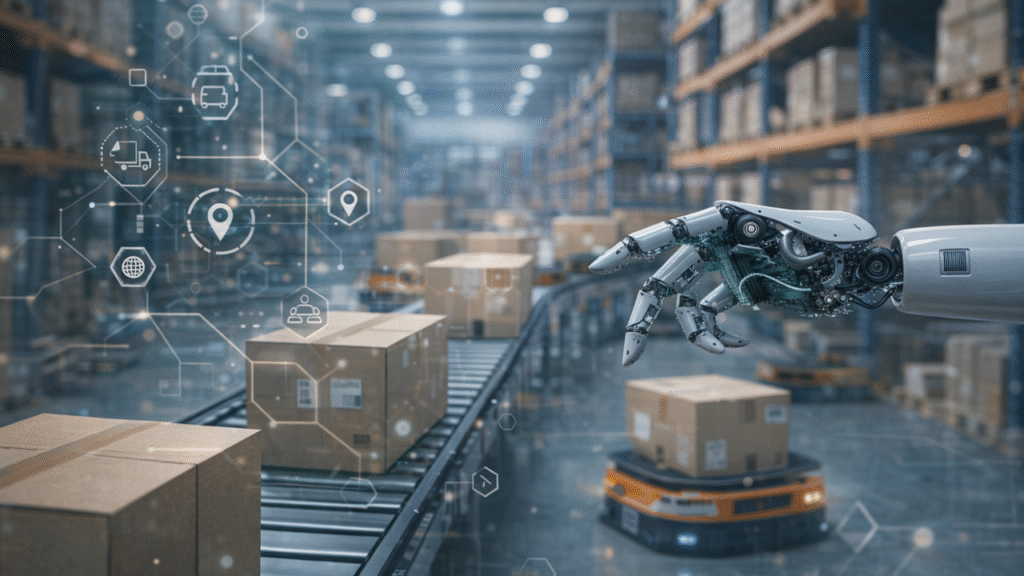
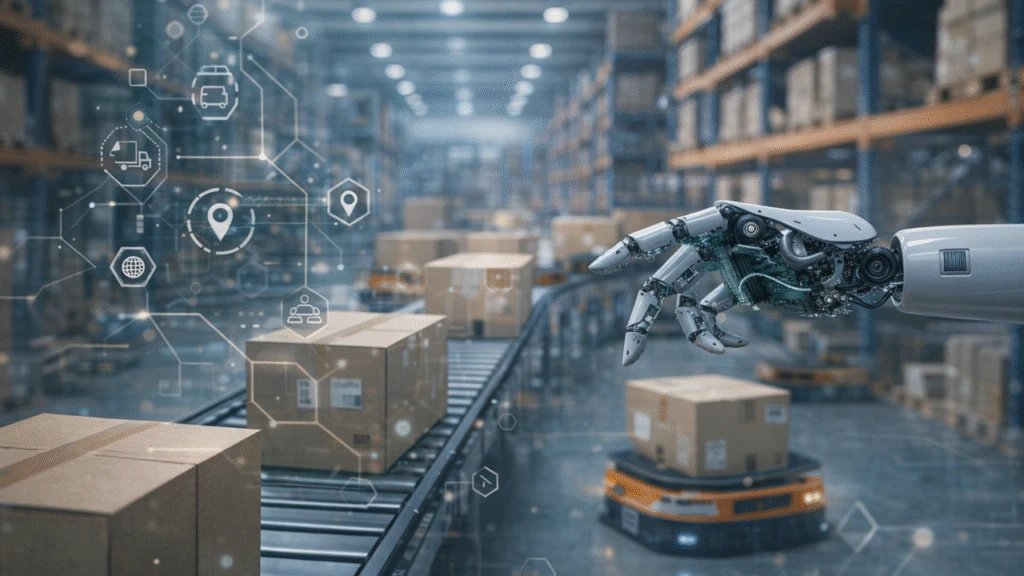
Physical AI represents the ultimate evolution of supply chain intelligence, building on simulation and agent AI and embodying that intelligence directly in the physical world. In the near future, humanoid robots and robotic systems will physically take over an increasing number of operational tasks in supply chain and logistics: from trailer unloading and sorting, pallet handling and replenishment, to packaging and labeling, and autonomous last-mile delivery.
As intelligence moves from screens to machines, supply chain and logistics may gain new physical agility. Microsoft is pushing the frontier of physical AI with its new Rho-alpha robotics model, which combines natural language, visual perception, and tactile feedback to make robots more adaptable and autonomous. Microsoft has launched an early-access research program with select partners to advance co-training and domain adaptation, with plans to integrate the model into Microsoft Foundry in the coming months.
Today, customers and partners can adopt the following robotics toolchain reference architecture to train and deploy warehouse robots on Azure using NVIDIA Osmo. The toolchain is an open-source, production-ready framework that integrates Azure cloud services with NVIDIA’s physical AI stack, from simulation to training and deployment. It combines Azure Machine Learning, Azure Kubernetes Services (AKS), Microsoft Fabric, Azure Arc, and NVIDIA’s robotics and AI stack.
Industry Applications and Partner Ecosystem
Microsoft’s Supply Chain 2.0 strategy has gained broad industry adoption. Hexagon Robotics has begun deploying this architecture using Azure IoT Operations and Fabric Real-Time Intelligence in Microsoft Fabric, delivering production-ready humanoid robot solutions. Their industrial humanoid robot AEON combines dexterity, mobility, and unique spatial intelligence to tackle complex industrial use cases in warehousing and logistics, such as inspection and inventory counting.
Microsoft-backed Figure AI uses Azure’s AI infrastructure to deploy its humanoid robots in real logistics environments. Their latest model, Figure 03, can take over warehouse tasks like sorting packages at conveyor-belt speeds and provides near-human-level precision in last-mile delivery. KUKA, in partnership with Microsoft, developed iiQWorks.Copilot, an AI-driven assistant that supports natural language robot programming, significantly simplifying automation tasks. By integrating Azure AI services, the solution enables users to design, test, and deploy robot workflows faster and more safely—reducing programming time for simple tasks by up to 80%.
Wandelbots’ NOVA software layer, combined with Azure cloud services, unifies heterogeneous robots and brings adaptive automation to the shop floor. Wandelbots NOVA simplifies warehouse and fulfillment operations like palletizing by streamlining robot programming, accelerating deployment, and enabling AI-driven path planning and scaling across multiple robot brands. These capabilities collectively make Wandelbots NOVA a physical AI platform for orchestrating and scaling AI-driven automation in supply chain operations.
Source: www.microsoft.com
Compiled from international media by the SCI.AI editorial team.