Explore

  • Trending
  • Latest
  • Tools
  • Browse
  • Subscription Feed

Logistics

  • Ocean
  • Air Cargo
  • Road & Rail
  • Warehousing
  • Last Mile

Regions

  • Southeast Asia
  • South Asia
  • Central Asia
  • Japan & Korea
  • Middle East
  • Europe
  • Russia
  • Africa
  • North America
  • Latin America
  • Australia
SCI.AI
  • Supply Chain
    • Strategy & Planning
    • Logistics & Transport
    • Manufacturing
    • Inventory & Fulfillment
  • Procurement
    • Strategic Sourcing
    • Supplier Management
    • Supply Chain Finance
  • Technology
    • AI & Automation
    • Robotics
    • Digital Platforms
  • Risk & Resilience
  • Sustainability
  • Research
  • Expert Columns
  • English
    • Chinese
    • English
No Result
View All Result
  • Login
  • Register
SCI.AI
No Result
View All Result
Home Risk & Resilience Geopolitics

South Korea Refiners Cut Output by 125K bpd Amid Force Majeure Crisis

2026/04/01
in Geopolitics
0 0
South Korea Refiners Cut Output by 125K bpd Amid Force Majeure Crisis

According to en.sedaily.com, escalating force majeure events—including the Iran war and a major fire at Anjeon Industry in Daejeon—are triggering cascading production halts across South Korea’s industrial supply chains. Refiners have reduced crude processing volumes, automakers have suspended vehicle assembly, and airlines are canceling routes amid fuel shortages and procurement constraints.

Refining Sector Slows Amid Crude Procurement Pressures

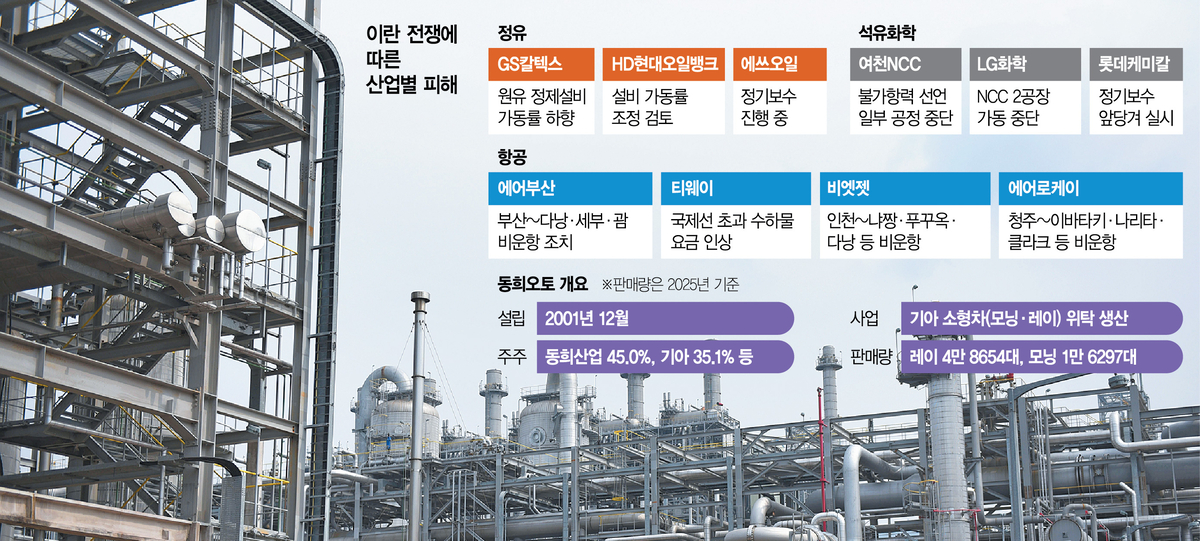
GS Caltex recently cut its daily crude oil refining volume from 800,000 barrels to 675,000 barrels—a reduction of 125,000 barrels per day. The company is also reviewing further cuts to its refining facility utilization rate. Other major refiners are responding similarly: S-Oil entered scheduled maintenance this month and shut down one of three refining units at its Onsan plant; SK Energy and HD Hyundai Oilbank have advanced their planned maintenance timelines. HD Hyundai Oilbank and remaining refiners are actively monitoring crude oil supply conditions and assessing additional utilization adjustments.

This contraction follows the South Korean government’s implementation of a price ceiling and export controls on the 13th—measures that have intensified profitability pressure on refiners already strained by geopolitical volatility in the Middle East.

Cascading Impact on Petrochemicals and Auto Production

The decline in refining volumes directly threatens petrochemical operations, as naphtha and other base feedstocks—produced during refining—are essential raw inputs. Reduced output will inevitably squeeze petrochemical plant utilization rates further.

Meanwhile, the fire at Anjeon Industry—a key automotive engine valve supplier based in Daejeon—has triggered a critical bottleneck. Anjeon supplies more than half of the engine valves used by Hyundai Motor and Kia. As a result, Donghee Auto—which exclusively contract-manufactures Kia’s Morning and Ray models—halted operations at its Seosan plant from the afternoon of April 1 through April 11. The Ray, a steady seller with 48,654 units sold last year, already faces delivery delays of seven months for the conventional model and eight months for the Ray EV; the shutdown is expected to extend those lead times.

Donghee Auto receives engines from Hyundai Wia, which has reportedly curtailed supply volumes following the fire.

Airline Route Cuts Reflect Jet Fuel Shortages

Airlines are responding to jet fuel scarcity with widespread route adjustments. China Southern Airlines canceled select flights on the Incheon–Changchun route from April 1–10. VietJet Air implemented an emergency suspension of the Incheon–Phu Quoc route for all of April and reduced frequency on the Busan–Nha Trang route from seven flights per week to four. Aero K plans partial suspension of four international routes—Cheongju–Ibaraki, Cheongju–Narita, Cheongju–Clark, and Cheongju–Ulaanbaatar—from next month through June 23. T’way Air (091810.KS) announced it will raise excess baggage fees on most international routes starting April 30.

Broader Industry Concerns

Korean industry stakeholders warn that persistent disruptions from geopolitical crises and industrial accidents could erode mid- to long-term competitiveness. The refining and petrochemical sectors—already impacted by fallout from the Iran war—face inevitable profitability deterioration if Middle East instability endures.

Source: en.sedaily.com

Compiled from international media by the SCI.AI editorial team.

More on This Topic

  • STG Logistics Reorganization Approved — 90% Debt Cut (May 20, 2026)
  • Mecalux Unveils AI Agents — Logistics Business (May 20, 2026)
  • Locus Robotics收购Nexera Robotics — Logistics Business (May 20, 2026)
  • Savannah Port Volumes Down 14% — gCaptain (May 20, 2026)
  • AI Boom vs Helium Crisis: 5% of Air Cargo at Risk — The Loadstar (May 20, 2026)
ShareTweet

Related Posts

STG Logistics Reorganization Approved — 90% Debt Cut
AI & Automation

STG Logistics Reorganization Approved — 90% Debt Cut

May 20, 2026
2
Mecalux Unveils AI Agents — Logistics Business
AI & Automation

Mecalux Unveils AI Agents — Logistics Business

May 20, 2026
4
Locus Robotics收购Nexera Robotics — Logistics Business
AI & Automation

Locus Robotics收购Nexera Robotics — Logistics Business

May 20, 2026
1
Savannah Port Volumes Down 14% — gCaptain
AI & Automation

Savannah Port Volumes Down 14% — gCaptain

May 20, 2026
2
AI Boom vs Helium Crisis: 5% of Air Cargo at Risk — The Loadstar
AI & Automation

AI Boom vs Helium Crisis: 5% of Air Cargo at Risk — The Loadstar

May 20, 2026
2
Allianz Trade Launches Green2Green, 98 Policies Issued
Geopolitics

Allianz Trade Launches Green2Green, 98 Policies Issued

May 20, 2026
3

Leave a Reply Cancel reply

Your email address will not be published. Required fields are marked *

Recommended

自主业务规划不仅可能,它已经到来了

Self-directed Business Planning is Not Only Possible, It Has Arrived

11 Views
February 16, 2026
Strategic Diversion and Systemic Resilience: How Saudi Arabia, UAE, and Oman Are Rewiring Gulf Supply Chains Amid Hormuz Instability

Strategic Diversion and Systemic Resilience: How Saudi Arabia, UAE, and Oman Are Rewiring Gulf Supply Chains Amid Hormuz Instability

12 Views
March 24, 2026

ASEAN 11-Nation Bloc: 683M People, $4.167T GDP

26 Views
April 12, 2026
AI-Powered Supply Chain Visibility: The 2026 Evolution from Real-Time Tracking to Predictive Intelligence

AI-Powered Supply Chain Visibility: The 2026 Evolution from Real-Time Tracking to Predictive Intelligence

8 Views
March 1, 2026
Show More

SCI.AI

Global Supply Chain Intelligence. Delivering real-time news, analysis, and insights for supply chain professionals worldwide.

Categories

  • Supply Chain Management
  • Procurement
  • Technology


  • Risk & Resilience
  • Sustainability
  • Research

© 2026 SCI.AI. All rights reserved.

Powered by SCI.AI Intelligence Platform

Welcome Back!

Sign In with Facebook
Sign In with Google
Sign In with Linked In
OR

Login to your account below

Forgotten Password? Sign Up

Create New Account!

Sign Up with Facebook
Sign Up with Google
Sign Up with Linked In
OR

Fill the forms below to register

All fields are required. Log In

Retrieve your password

Please enter your username or email address to reset your password.

Log In

Scan to share via WeChat

Open WeChat and scan the QR code to share

QR Code

Add New Playlist

No Result
View All Result
  • Supply Chain
    • Strategy & Planning
    • Logistics & Transport
    • Manufacturing
    • Inventory & Fulfillment
  • Procurement
    • Strategic Sourcing
    • Supplier Management
    • Supply Chain Finance
  • Technology
    • AI & Automation
    • Robotics
    • Digital Platforms
  • Risk & Resilience
  • Sustainability
  • Research
  • Expert Columns
  • English
    • Chinese
    • English
  • Login
  • Sign Up

© 2026 SCI.AI